
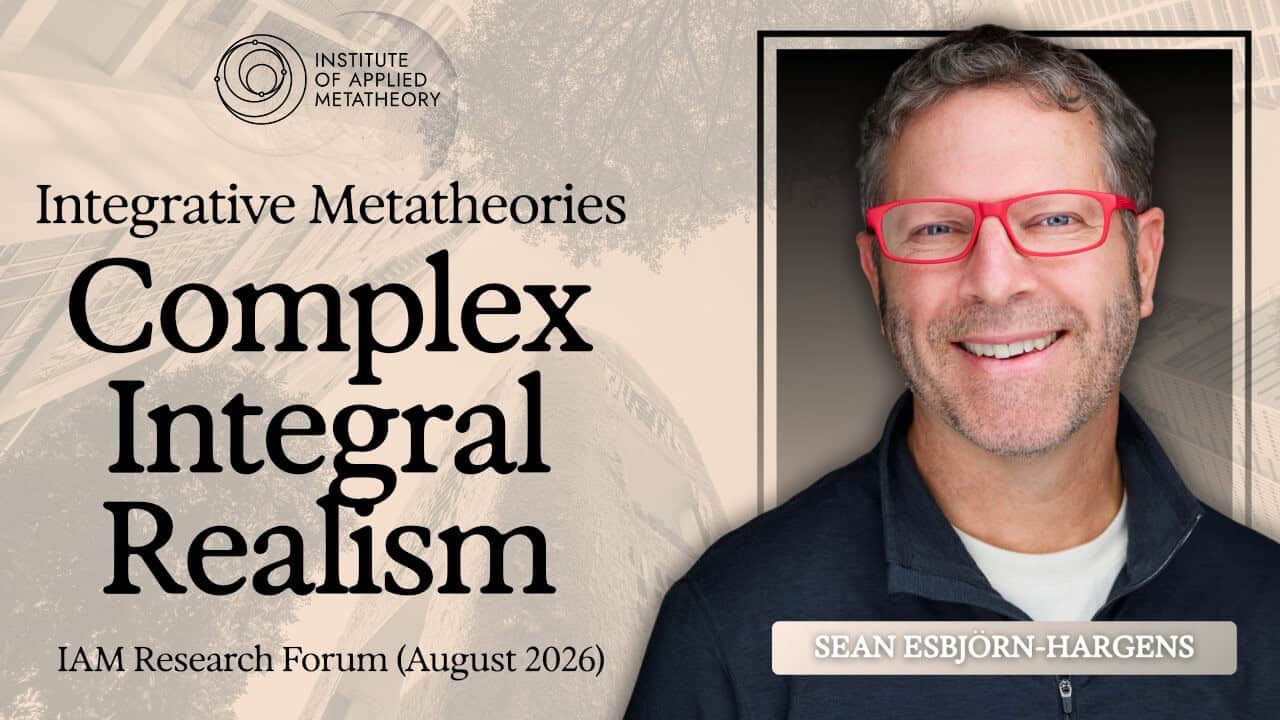
How big is your integral theory of everything, and what does your everything leave out? Sean Esbjörn-Hargens has spent two decades on that question. His framework, Complex Integral Realism, puts Ken Wilber’s integral theory, Roy Bhaskar’s critical realism, and Edgar Morin’s complex thought into sustained dialogue, each standing on its own terms rather than folded into one master model.
In this IAM Research Forum session, he walks through how the framework came together and what each tradition brings, from Wilber’s map of consciousness and development, to Bhaskar’s depth ontology and critical philosophy, to Morin’s complexity science and self-reflexive epistemology. He argues for an integrative pluralism over an integrative monism, with no single ring to rule them all, and for a post-formal metatheory that can hold paradox and ambiguity without flattening them. Running underneath is his central claim, that even our biggest maps need to do shadow work. What are they leaving out? What are they quietly repressing?
Watch or listen · 1:24:16
Sean Esbjörn-Hargens, Nick Hedlund
Sean Esbjörn-Hargens
“Awesome.”
Chapters (7)
Held with integral theory
Where they meet. Esbjörn-Hargens built Complex Integral Realism on Wilber’s work and keeps much of it. He opens with Wilber’s own words: that he holds “this integral critical theory very lightly,” and that he hopes his tombstone will say he “was true but partial.” He also finds that all three of his sources, Wilber, Bhaskar and Morin, are “all quadrant” and “all level, maybe not in the ways that Wilber is.”
Is integral one ring to rule them all?
The challenge. Esbjörn-Hargens took Wilber at his word and asked whether integral theory “is not as integral as it thinks it is.” In 2013 he set out to move the integral community away from “a Wilber centric orientation.” He borrows Mark Edwards’s terms. Edwards warns against “the biggest and the brightest super theory that subsumes other explanations” and asks for an integrative pluralism that respects theories’ “often conflicting differences.” Esbjörn-Hargens wants that for CIR, with “slight preservative synthetic tendencies.”
The reply. Wilber describes integration as a way of freeing views. Integral theory, he says, shows “that everybody is right by showing that everybody is true but partial.” It frees each view “by limiting” it and placing it beside others, so that bigger pictures carry “less and less and less absolutism.”
“Yeah, exactly. And I think perspectival therapy and perspectival therapists is a wonderful.”
Ken Wilber
Become a member to hear it.
Where it lands. A real difference, though narrower than the slogan. Both reject a theory that rules the others. Wilber frees views by bringing them into “coherent frameworks.” Edwards, whom Esbjörn-Hargens follows here, links whole frameworks while respecting their conflicts. It decides whether a clash between Wilber and Bhaskar gets a place on the map or stays open.
Whose frame does the comparing?
The challenge. Integral’s strongest answer turns the question around. Wilber argued that postmodernism, “in explaining why there are no big pictures,” holds a universal one, and so contradicts itself. A pluralism of big pictures faces a milder version of that problem: it has to compare them from somewhere. Esbjörn-Hargens calls CIR “a metatheory of metatheories.”
“actively discouraged. And postmodernism itself can be sort of summarized with the view that, quote, there are no big pictures. So we've lost that.”
Ken Wilber
Become a member to hear it.
The reply. He grants the point. When a participant said his first-, second- and third-person lens carries its own assumptions, he agreed that the lens “comes out of Wilber’s model” and that using “Wilber’s architecture as the architecture of comparison” is not quite fair. His answer is more lenses: a comparison in “a predominantly Bhaskarian frame,” and another in Morin’s.
Where it lands. A real difference, smaller than it first looks. Esbjörn-Hargens doesn’t claim to stand nowhere. He names his lens and offers to change it. What stays open is whether moving between Wilber’s, Bhaskar’s and Morin’s frames still needs one frame to weigh the results, as Wilber’s argument suggests. If it does, integrative pluralism needs a ring after all, held lightly.
What holding both shows. Held together, integral supplies much of CIR’s machinery, and CIR turns integral’s own maxim back on it: if every view is true but partial, so is AQAL. Esbjörn-Hargens calls this shadow work for metatheories, and the forum’s critics pressed on both. Mark Edwards, whose meta-studies is also in this series, warned that integrative “towers of Babel” end up “building the falseness upon the falseness,” since perspectives are “also false and partial.” Sean Kelly asked that Morin not be limited “to the it,” since Morin has his own big three of individual, society and species.
About Sean Esbjörn-Hargens
Sean Esbjörn-Hargens, Ph.D. is one of the world’s leading experts on Integral Theory and its application. Building on the vision of American philosopher Ken Wilber, he has played a significant role in creating the academic field of Integral Theory. He is co-author of Integral Ecology and editor of Integral Theory in Action and Integral Education.