What Is Complex Thought? A Deeper Dive into Edgar Morin

What Is Complex Thought? A Deeper Dive into Edgar Morin

In this episode of the Integration podcast, Sean Kelly joins Nick Hedlund and Brendan Graham Dempsey to go deeper into the complex thought of Edgar Morin. Put simply, Kelly says, complex thought is an invitation to a practice of the heart-mind, a way to stay connected and to stay real. Reality is complex, and making sense of it often takes ideas that seem to exclude one another. Faced with that, our habit is to simplify, which is understandable, since we often need to simplify just to get by. But as societies grow more complex, simplification turns harmful. It leads to...
Integrative Metatheories: Edgar Morin’s Complex Thought

Integrative Metatheories: Edgar Morin’s Complex Thought

In this IAM Research Forum session, Sean Kelly introduces the complex thought of Edgar Morin, his mentor and friend of nearly forty years. Morin coined the word polycrisis in 1992, long before it went viral, and was convinced that a world this entangled can’t be understood by a way of thinking that cuts it into separate pieces.
What Is Archdisciplinarity Really?

What Is Archdisciplinarity Really?

In this episode of the Integration podcast, Cory David Barker joins Nick Hedlund and Brendan Graham Dempsey to go deeper into archdisciplinarity, the study of what the big unifying frameworks have in common. It began with a puzzle: a universal model of structure and a universal model of process seemed to rest on the same underlying recursion, a pattern Barker traces back to Turing and Church. He explains why he writes his arches as theorems and axioms, so people can disagree with them one claim at a time, and why formal science is the field big-picture thinking has most neglected.
Why Meaning Isn’t Just Made Up

Why Meaning Isn’t Just Made Up

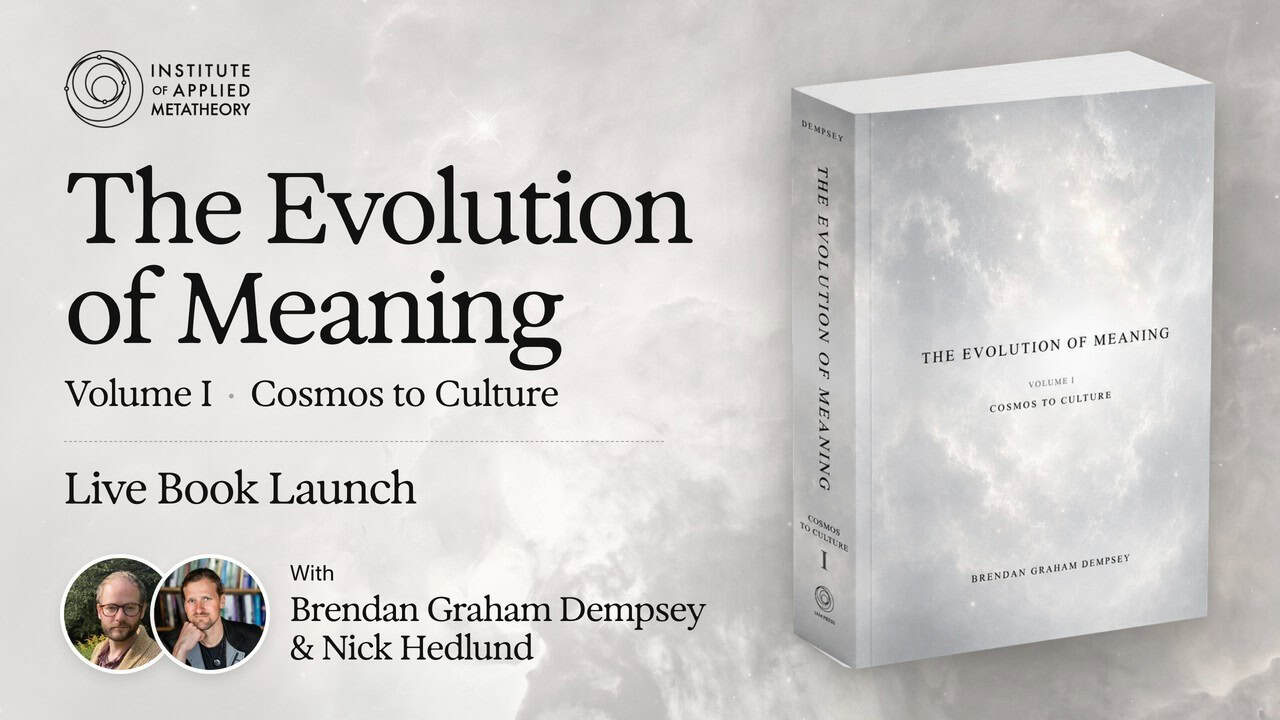
We usually think of meaning as something deeply personal—a purpose we discover, a story we tell, or a value we choose. But what if meaning also has a much longer history?
What Is Archdisciplinarity?

What Is Archdisciplinarity?

In this IAM Research Forum session, Cory David Barker introduces archdisciplinarity, the next step in a sequence that runs from disciplines through interdisciplinary and transdisciplinary work. With a couple hundred big-picture frameworks now claiming to fit all of human knowledge together, the frameworks themselves become the thing to study, and Barker goes looking for what they share: a small set of universal patterns he calls arches, recurring at every scale from atoms to sentences. Can grand theories be compared impartially? What does it mean that, as Barker argues, everything is already a singularity? And once intelligence can be mapped this...
The Emergence of an Integrative Worldview

The Emergence of an Integrative Worldview

In this IAM Research Forum session, Robb Smith, Nick Hedlund, Brendan Graham Dempsey and Clément Vidal make the case that a new, integrative worldview is emerging in our lifetimes, and that the worldviews we inherited are no longer fit for the century we live in. Clément Vidal traces the arc: a first story in which the world follows God's law, a second in which it follows physical law and, as Steven Weinberg put it, seems more pointless the more comprehensible it becomes, and a third in which evolution has a direction and meaning comes back into the picture. The task...
Alfred North Whitehead’s Process Philosophy: A Deeper Dive

Alfred North Whitehead’s Process Philosophy: A Deeper Dive

In this episode of the Integration podcast, Andrew M. Davis joins Nick Hedlund and Brendan Graham Dempsey for a deeper dive into process philosophy. Does interiority emerge somewhere along the evolutionary way, as emergentists hold, or does it go all the way down, as panpsychists do? And if it goes all the way down, what could feeling possibly mean at the level of an atom? Where does Whitehead land between idealism and realism, and would he count as a metamodern neorealist? What is matter, once solidity dissolves into events? And when God arrives as the chief exemplification of the metaphysics...
Integrative Metatheories: Alfred North Whitehead’s Process Philosophy

Integrative Metatheories: Alfred North Whitehead’s Process Philosophy

In this wide-ranging IAM Research Forum session, Andrew M. Davis introduces process philosophy and the metaphysics of Alfred North Whitehead. Whitehead spent his first career as a mathematician, co-writing Principia Mathematica, and turned to metaphysics only in his sixties, after Harvard offered him a chair in philosophy. What came of that turn was a philosophy insisting that nothing in experience may be left out, that certainty is folly, and that value is something nature proclaims to us rather than something we project onto it. Those claims get their fullest expression in Process and Reality, the 1929 Gifford Lectures that made...
Metamodernism: A Deeper Dive

Metamodernism: A Deeper Dive

Jason Ānanda Josephson Storm joins Nick Hedlund and Brendan Graham Dempsey for a deep dive into metamodernism. Where does a worldview actually live, in an individual or in a culture, and what do we do with the fact that people are rarely as consistent as the concept assumes? Does a false belief become real the moment it makes something happen? How does a theory of language written for scholars end up shaping the way a whole country argues about facts? The answers keep turning on ontology, and on what "real" is being contrasted with in any given sentence, a question...
Integrative Metatheories: Metamodernism

Integrative Metatheories: Metamodernism

Postmodernism gave scholars license to doubt everything except its own doubting, and by the turn of the century that was delivering diminishing returns. So what comes after it? Jason Ānanda Josephson Storm makes the case for metamodernism as the way through, one that keeps what critique got right while reworking realism, social ontology, language, knowledge, and value. What if skepticism that cannot doubt itself is simply another dogma? What if "real" means little until you answer real as opposed to what? And what if value neutrality, that great methodological virtue, has been a value all along, one that cost the...
What Are Big Pictures Actually For?

What Are Big Pictures Actually For?

Sean Esbjörn-Hargens joins Nick Hedlund and Brendan Graham Dempsey for a deep dive on Complex Integral Realism, and a bigger question surfaces: what does integrative metatheory actually do in the world? The maps are enormous, and the applications so far are small and slow. Does a bigger picture hand you more leverage, or mostly a clearer view of how little leverage you have? One answer is that the payoff runs through the person doing the looking, where becoming more integratively literate changes how you read a situation long before you try to intervene in it. Another is that a big...
Integrative Metatheories: Complex Integral Realism

Integrative Metatheories: Complex Integral Realism

How big is your integral theory of everything, and what does your everything leave out? Sean Esbjörn-Hargens has spent two decades on that question. His framework, Complex Integral Realism, puts Ken Wilber's integral theory, Roy Bhaskar's critical realism, and Edgar Morin's complex thought into sustained dialogue, each standing on its own terms rather than folded into one master model.
A Closer Look at Visionary Realism

A Closer Look at Visionary Realism

Nick Hedlund describes Visionary Realism as an attempt to sketch a worldview adequate to the complexity and sacredness of reality, one built on reverence, humility, and listening. In this episode of the Integration podcast, he talks with Brendan Graham Dempsey about what stands in the way: the split Kant first named between what's knowable and what's real, a divide Hedlund traces forward into postmodernism and treats as the hidden engine of the metacrisis.
Integrative Metatheories: Visionary Realism

Integrative Metatheories: Visionary Realism

Nick Hedlund calls the metacrisis a forcing function for humanity's self-understanding, asking us to rethink what reality is, what a human being is, what nature and the sacred are. Visionary Realism is his answer: a philosophical framework built as a root level response to the metacrisis in service of radical planetary flourishing, forged by putting two serious traditions, Roy Bhaskar's critical realism and Ken Wilber's integral theory, into sustained dialogue, letting each transfigure the other into something genuinely new.
Roy Bhaskar’s Critical Realism: A Closer Look

Roy Bhaskar’s Critical Realism: A Closer Look

In this episode of the Integration podcast, Leigh Price sits down with Nick Hedlund and Brendan Graham Dempsey to go further into critical realism than her IAM Research Forum talk had room for. She traces Roy Bhaskar's philosophy through its major phases, from transcendental realism through dialectical critical realism, where his concept of absence resolves long-standing puzzles in the Hegelian and Marxist dialectic.
Going Deeper into Integral Theory

Going Deeper into Integral Theory

In this episode of the Integration podcast, Bruce Alderman returns for a deeper look at integral theory, continuing the conversation he opened at the IAM Research Forum. Joined by Brendan Graham Dempsey and Nick Hedlund, he traces Wilber's path into integral theory from its roots in transpersonal psychology through the five moving parts of the AQAL model: quadrants, levels, lines, states, and types.
Integrative Metatheories: Integral Theory & Critical Realism

Integrative Metatheories: Integral Theory & Critical Realism

What is actually real, and how do we know it? Roy Bhaskar built a philosophy of science arguing that reality runs deeper than what we can observe, with real structures and causes behind the events we see, and made that philosophy the engine of an emancipatory politics. Ken Wilber built a map of the different ways people grow, know, and experience the world. This IAM Research Forum session brings scholars of both traditions, critical realism and integral theory, into direct dialogue.
From Matter to Mind: Inside the Unified Theory of Knowledge

From Matter to Mind: Inside the Unified Theory of Knowledge

In this episode of the Integration podcast, Dr. Gregg Henriques joins Brendan Graham Dempsey and Nick Hedlund for a deeper dive into the Unified Theory of Knowledge. His earlier presentation at the IAM Research Forum established the philosophical context; this conversation goes inside the model itself.
Why Integrative Metatheory 2.0 Now?

Why Integrative Metatheory 2.0 Now?

In this episode of the Integration podcast, Robb Smith joins Nicholas Hedlund and Brendan Graham Dempsey to make the case for Integrative Metatheory 2.0. Drawing on a project that began with Sean Esbjörn-Hargens' meta-integral work in 2010-2013, they explore how frameworks like critical realism, Edgar Morin's complex thought, and metamodernism entered the conversation alongside integral theory, and what it now takes to bring them into genuine dialogue.
Integrative Metatheories: Unified Theory of Knowledge

Integrative Metatheories: Unified Theory of Knowledge

Modern science has produced an increasingly sophisticated picture of the physical world. Where it has persistently struggled is in placing mind and consciousness within that picture. Gregg Henriques calls this the Enlightenment Gap, and he argues it sits at the root of the metacrisis.
Invitation and Gameplan for Contributing to an Integrative Metatheory 2.0

Invitation and Gameplan for Contributing to an Integrative Metatheory 2.0

The metacrisis runs deeper than most accounts suggest. Beneath the visible crises of governance and climate lies a more fundamental problem: the fragmentation of knowledge itself. Integrative metatheory has been the most sustained attempt to address this, bringing the broad sweep of human understanding toward a coherent worldview. This session marks the official launch of that effort's next chapter.
An Intersubjective Epistemology for Social Science

An Intersubjective Epistemology for Social Science

Dr. Michael Mascolo, Professor of Psychology at Merrimack College, presents a provocative challenge to psychology's foundational assumptions about how we gain knowledge.
What Makes One Worldview Better Than Another?

What Makes One Worldview Better Than Another?

What makes one worldview better than another? While science has clear criteria for evaluating theories — internal consistency, explanatory power, experimental support — philosophy has lacked an equivalent framework. Until now.
Metapatterns Across Reality: From Quarks to Mind and Culture

Metapatterns Across Reality: From Quarks to Mind and Culture

This is a rich, cross-disciplinary exploration for those interested in: systems thinking, big history, evolution, complexity science, Gaia theory, and metatheory.
1 2