
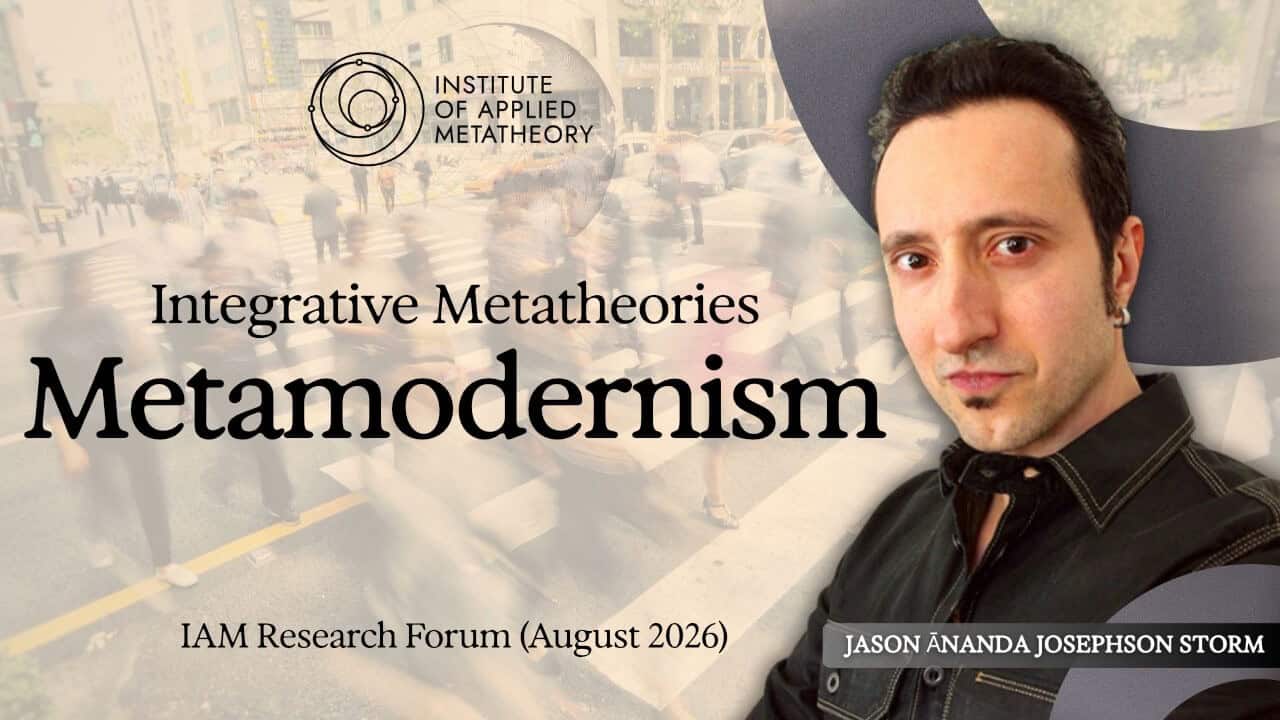
Postmodernism gave scholars license to doubt everything except its own doubting, and by the turn of the century that was delivering diminishing returns. So what comes after it? Jason Ānanda Josephson Storm makes the case for metamodernism as the way through, one that keeps what critique got right while reworking realism, social ontology, language, knowledge, and value. What if skepticism that cannot doubt itself is simply another dogma? What if “real” means little until you answer real as opposed to what? And what if value neutrality, that great methodological virtue, has been a value all along, one that cost the humanities much of their reason to matter?
Watch or listen · 1:25:56
Jason Ānanda Josephson Storm
Jason Ānanda Josephson Storm
“Great. Thank you. It's a real pleasure to be here chatting for you all.”
Chapters (8)
Held with integral theory
Where they meet. Storm says he has “not actually read Wilber,” so the overlaps are independent. Both credit postmodern critique and find it undermining itself. Storm calls value neutrality “itself a value” and says postmodern skepticism, “unable to doubt itself,” stopped doing the work scholars needed. Wilber has long charged postmodern relativism with a performative contradiction: the claim that no value is better than another is itself a claim to a better value.
Is “modern” too blunt a word?
The challenge. Mark Edwards asked Storm about periodization, which he called “very dominant within integral thinking.” Storm answered that “modern” bundles many different ruptures, treats them as one thing and “makes an agent” out of entangled processes. Citing Cornel West, he notes that Black Americans in the high postmodern moment did not show what theorists called postmodern culture. He will name postmodernism within a field such as philosophy, but of grand periodizations, “I tend to be skeptical.”
The reply. Wilber agrees that broad eras can pigeonhole people. In his account a culture has a “general center of gravity,” where most of its people are; many are beyond it and some fall short of it. Integral historiography, he says, keeps both the generalization and the exceptions.
“And one of the things that we want to recognize is that Every culture tends to have a general center of gravity.”
Ken Wilber
Become a member to hear it.
Where it lands. Partly a matter of wording: neither treats an era as uniform. A real difference remains. For Wilber, an era’s stage is the center of gravity of the people in it, so it can be studied and has exceptions. Storm doubts that one word can carry the many changes it bundles; he would rather name one process, such as industrialization, and study that. The question is whether “modern” names a stage of development or a stretch of history.
Can values be ranked?
The challenge. Storm wants scholars to state their values and argue for them. Integral asks what makes one value better than another. Wilber’s answer is development: worldcentric care is better than ethnocentric care because it is a later stage, and because “the more perspectives you take into account in making a decision the more ethical that decision is attempting to be.”
“So if you look at Carol Gilligan's simple three or four stages of female ethical... development. She called them selfish care, universal care and integrity.”
Ken Wilber
Become a member to hear it.
The reply. Storm does not rank values by stage. He holds that an “ought” can follow from an “is” once people share a goal: grant that you want to win at chess, and he can tell you which move to make. He offers “multi-species flourishing” as a goal “we could agree on,” and wants places “where we can argue and debate,” which he calls agonism, so that integration does not “overly homogenize.”
Where it lands. A real difference, narrower than it looks. Multi-species flourishing reaches as far as Wilber’s own rule, “the greatest depth for the greatest span.” They part on where a ranking comes from: Wilber reads it from development, while Storm builds it from goals people agree to in open argument. That decides whether a metatheory may call one person’s values more developed than another’s.
What holding both shows. Storm’s demand for specific terms fits integral’s own method: Wilber’s historiography looks at an era’s worldview, values, laws, institutions and techno-economic base, so “modern” can be dated separately in each quadrant. Storm’s process social ontology, which asks how social categories are made real and kept going, could give integral’s lower quadrants a sharper account of kinds like “art” or “society.” In this talk Storm also says Bhaskar’s layered “real” “mystifies things,” which sets his metamodernism apart from critical realism, also in this series.
About Jason Ānanda Josephson Storm
Jason Ānanda Josephson Storm is professor of religious studies and science and technology at Williams College. He received his master's degree from Harvard University and his PhD from Stanford University. His research focuses on Japanese religions, European intellectual history and theory more broadly. His book Metamodernism: The Future of Theory (2021) offers research methods for the humanities and social sciences that both radicalize and move beyond postmodernism.