
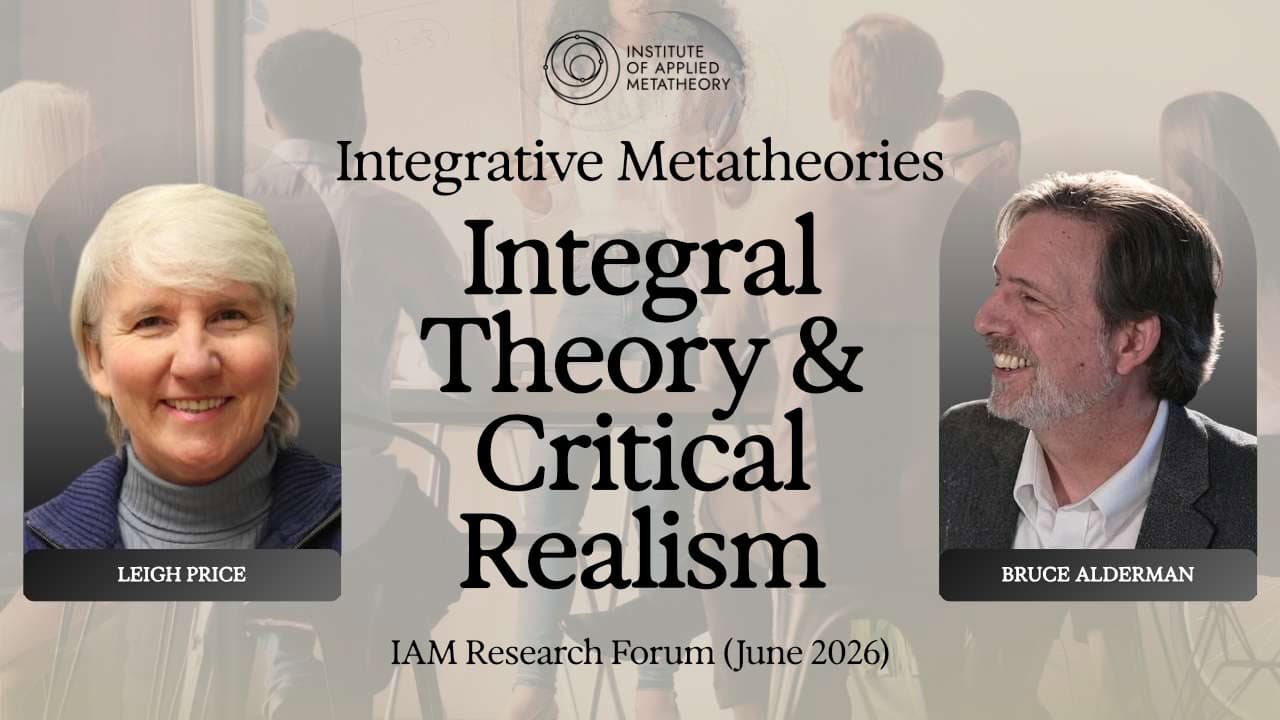
What is actually real, and how do we know it? Roy Bhaskar built a philosophy of science arguing that reality runs deeper than what we can observe, with real structures and causes behind the events we see, and made that philosophy the engine of an emancipatory politics. Ken Wilber built a map of the different ways people grow, know, and experience the world. This IAM Research Forum session brings scholars of both traditions, critical realism and integral theory, into direct dialogue.
Leigh Price, who worked directly with Bhaskar and now directs the Roy Bhaskar Centre, walks through his ideas in five stages, from his account of what’s real versus what’s merely observed, through his model of how individuals and society shape each other, to the emancipatory and even spiritual turns his thinking eventually took.
Bruce Alderman traces what happened to Wilber’s four-quadrant map, the many scholars who revised, corrected, and extended it. He then shares his own contribution: a way of reading any big framework by the grammar it’s built on, and a concept called “heno-ontology” for how frameworks like these can hold each other up without any one swallowing the rest.
The two ideas meet directly when Price and Alderman work through a shared example (a set of cutlery) that shows their frameworks converging on the same insight from different directions. From there the conversation turns to a bigger question: what would it look like for frameworks like these to actually work together, and how do you make ideas this rich usable for people who aren’t scholars.
Watch or listen · 1:26:30
Bruce Alderman, Leigh Price
Leigh Price
“Okay, thanks.”
Chapters (7)
Held with integral theory
Where they meet. Price and Alderman both present philosophies built against reduction. Price says philosophy has tended to reduce ecosystems to the organisms in them and society to its people “because we can measure people and things.” Alderman names “anti-reductionist attention” as one of integral theory’s lasting yields.
Does integral fold being into knowing?
The challenge. Following Bhaskar, Price argues that scientific knowledge must be about something, and much of that something is hidden: reality has depth below what we can see or measure. Bhaskar called shrinking what is down to what we can know the epistemic fallacy, and critical realists in the dialogues charged Wilber’s later work with it.
The reply. In his 2015 Integral Theory Conference keynote, Wilber answered the charge. What we see, he said, comes from the object and also from the methods and ways of knowing we bring to it. “This is not an epistemic fallacy.” Looking at a heated iron rod will not show its heat; touching it will.
“What we see out there is a product not just of a given ontology of the item seen, but also of the methodology and epistemology we bring to see it.”
Ken Wilber
Become a member to hear it.
Where it lands. A real difference. Wilber rejects subjective idealism, and later in the talk he calls the idea that “all objects are nothing but enacted” “simply not true.” The critical realist charge is narrower: that integral makes what is wait on how it is known. For Wilber, the rod’s being and the ways it is known are “inseparable aspects” of one whole; Bhaskar’s rod has its powers whether or not anyone knows them. Alderman says Wilber’s turn to “modes of enactment” drew “some caution and some correction” from critical realism. It decides whether a better theory finds more of what was there or brings forth a new version.
Is a society made of its members?
The challenge. Wilber defines a social holon as “an individual holon plus its exchanged artifacts.” Bhaskar, as Price lays it out, starts from the other end. Society depends on people but is “qualitatively different” from them: it is there before we are born, gives us “enablements and constraints,” and goes on after we die.
The reply. Wilber also treats a society as a different kind of whole. When his dog walks, every cell goes with it, but “no society has anything like that control over its members.” An individual has a dominant monad, he says, generalizing Whitehead; a social holon has “a dominant mode of discourse,” resting on values and purposes most members can agree on.
“If you, I always use my dog as an example, an individual hold on, and if my dog decides to get up and walk across the room, 100% of its…”
Ken Wilber
Become a member to hear it.
Where it lands. A real difference. Neither treats a society as a heap of people or one big organism. They differ on what comes first: Bhaskar’s society is in place before its members and acts on them through its structures; Wilber’s holds together through a shared discourse, alongside his lower-right systems. That matters for critique, since structures can bind people who never agreed to them. Price says Bhaskar vindicated ontology “to allow for critique of oppressive and unjust systems.”
What holding both shows. Robb Smith summed up the pair: critical realism “brings us back to the real,” and integral offers a “gesture to epistemology.” Alderman’s heno-ontology lets neither swallow the other. He reads critical realism’s co-presence, Morin’s hologrammatic relation and integral’s non-duality as one relation in three forms: “They all contain each other in important ways.” Held together, Wilber’s zones say where a view stands and Bhaskar’s depth says what it looks at, a first piece of the “grammatical commons” Smith wants for UTOK, process thought, metamodernism and complex thought too.
About Leigh Price
Leigh Price is a Zimbabwean-born ecophilosopher who has worked mainly in environmental education. She is an Associate Professor at the Inland Norway University of Applied Sciences and a Research Associate of the Environmental Learning and Research Centre at Rhodes University, where she earned her PhD in environmental education. A former colleague of the critical realist philosopher Roy Bhaskar at the Institute of Education, University College London, she co-authored Interdisciplinarity and Wellbeing: A Critical Realist General Theory of Interdisciplinarity with Bhaskar and Berth Danermark. She has developed a philosophy for ecology that she calls "deep naturalism."

About Bruce Alderman
Bruce Alderman, MA, is an affiliate faculty at John F. Kennedy University in the Consciousness and Transformative Studies and Holistic Counseling Psychology departments. After years of moderating several integral discussion forums of his own, including Integral Postmetaphysical Spirituality and Integral Scholarship and Practice, he is venturing into production of integral video content himself.