
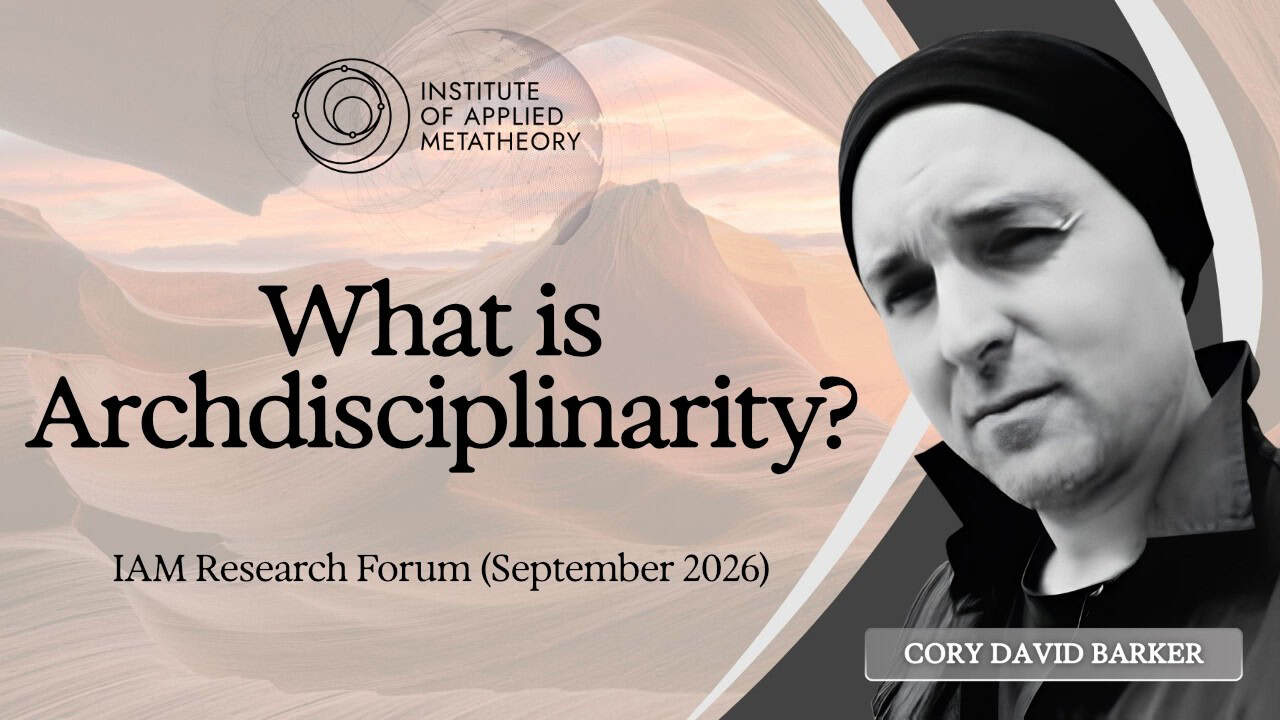
In this IAM Research Forum session, Cory David Barker introduces archdisciplinarity, the next step in a sequence that runs from disciplines through interdisciplinary and transdisciplinary work. With a couple hundred big-picture frameworks now claiming to fit all of human knowledge together, the frameworks themselves become the thing to study, and Barker goes looking for what they share: a small set of universal patterns he calls arches, recurring at every scale from atoms to sentences. Can grand theories be compared impartially? What does it mean that, as Barker argues, everything is already a singularity? And once intelligence can be mapped this precisely, what happens when it can be programmed?
Watch or listen · 1:36:28
Cory David Barker
Cory David Barker
“Thank you.”
Chapters (9)
Held with integral theory
Where they meet. Barker’s basic pattern is a recursion: units form relations, the relations form a system, and the system becomes a new unit, “nests within nests.” Wilber calls such whole-parts holons and builds his map on the same nesting. Barker also names “integral pluralism” as one of the methodological pluralisms an arch theory compares.
Is cognition computation?
The challenge. Barker makes universal computation his first arch, “a non-arbitrary universal basis for measurement across domains and scales,” and he still aims to build AGI. Wilber has argued that machine intelligence starts at formal operational thinking. Researchers scoop off that one stage and load it into computers, which leaves out “the feeling texture of consciousness” and every stage that led up to it, in people and in other animals.
“And what these researchers do, as I said, is that out of all of the literally hundreds of evolutionary transformational changes that have occurred to get up to formal operational…”
Ken Wilber
Become a member to hear it.
The reply. Barker names the objection himself: “how dare you compare human cognition in nature to computation.” He answers that modern computing came out of work at Princeton in the 1930s and 1940s, where people compared universal cognitive functions and then tried to build a machine that could replicate them. He also expects that “you can program different ways of knowing into a system,” a prospect he calls “very scary.”
Where it lands. A real difference. Barker’s program reaches past formal operations to many ways of knowing, staged as Michael Commons’s model of hierarchical complexity stages them. Wilber’s point is about what any such program leaves out: the felt interior that grows with a living body. In this talk Barker doesn’t say whether a system built from arches would have an Upper Left of its own, and that is the question integral would press.
Can emptiness be a possibility space?
The challenge. A participant asked how the arches, a “syntactical representation” of unification, relate to “the non-dual satori” known from within. Wilber has warned against a similar move in physics: calling an unmanifest field of potential Spirit, the source that “gives rise to this manifest world.” That makes Spirit dualistic. Non-dual Spirit “is the suchness of everything that’s arising” and “doesn’t cause anything to do anything.”
“And so, but the second fundamental mistake, once people move from saying, oh, something must be spiritual must be going on here, if they try to take something like the…”
Ken Wilber
Become a member to hear it.
The reply. Barker says big pictures lack formal science, and he thinks “formlessness can have a sort of formal science expression.” He finds it in the ruliad, Stephen Wolfram’s term for the “absolute possibility space” of every state and transformation a system can take. Emptiness, he says, is what “allows all possible things to come into existence.”
Where it lands. A real difference. For Wilber, whatever gives rise to the manifest world is not emptiness; it is one more level to study (he guesses prana). A map of it is still a third-person map, and “you can learn third-person maps and symbols and ideas. You’re not going to awaken.” Whether the ruliad describes emptiness or one more form arising in it decides what a formal arch can say about realization.
What holding both shows. The two may fit as two views of the same holons: Barker’s arches name what the big pictures share when you lay them over each other, and integral’s quadrants ask who is looking, and from where. In the discussion Barker’s work was called an “arch theory alpha,” which distills shared structures, beside Visionary Realism as an “arch theory beta,” which remakes theories through critique; Complex Integral Realism, also in this series, grows larger instead. All three face integral’s question: can a pattern found across maps include the interiors of the people who made them?
About Cory David Barker
Cory David Barker is a transdisciplinary and archdisciplinary scholar. He holds a Master of Arts in Social Science and Informatics and is pursuing a PhD in cognitive science at the University of Jyväskylä in Finland, where his research applies big picture thinking to AGI design. He led the multi-author book Foundations of Archdisciplinarity, which aims to establish archdisciplinarity as the study of big picture, transdisciplinary, theory of everything and unification metatheoretical frameworks. He is President of the Archdisciplinary Research Center.