
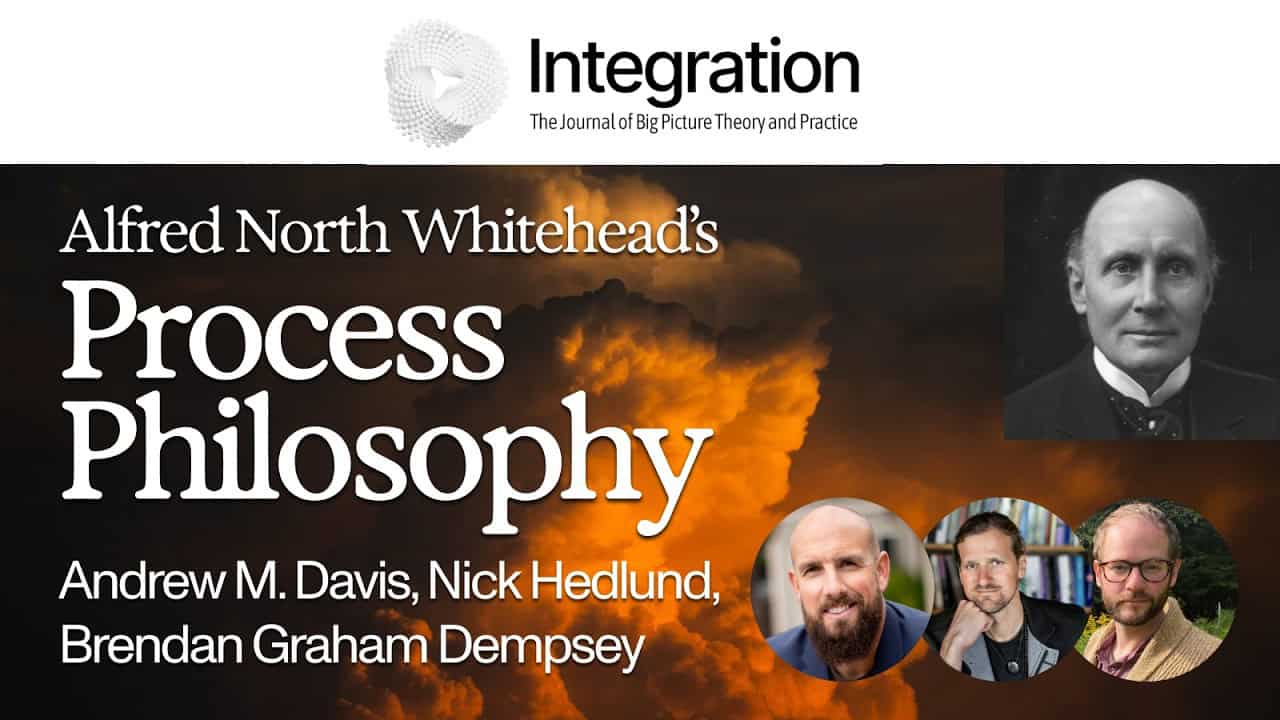
In this episode of the Integration podcast, Andrew M. Davis joins Nick Hedlund and Brendan Graham Dempsey for a deeper dive into process philosophy. Does interiority emerge somewhere along the evolutionary way, as emergentists hold, or does it go all the way down, as panpsychists do? And if it goes all the way down, what could feeling possibly mean at the level of an atom? Where does Whitehead land between idealism and realism, and would he count as a metamodern neorealist? What is matter, once solidity dissolves into events? And when God arrives as the chief exemplification of the metaphysics rather than an exception to it, does that survive Occam’s razor?
Watch or listen · 1:21:35
Andrew M. Davis, Brendan Graham Dempsey, Nicholas Hedlund
Brendan Graham Dempsey
“Yeah, awesome.”
Chapters (7)
Held with integral theory
Where they meet. Davis describes prehension as “a certain grasping through feeling” that runs all the way down in nature and “need not necessarily be conscious.” Wilber uses the same word for the interior of an atom. Both reject what Whitehead called the bifurcation of nature, in which, Davis says, science abstracts us out “beautifully” and forgets to put us back. Nick Hedlund calls integral theory neo-Whiteheadian in many ways.
Is a moment one subject, or four sides at once?
The challenge. Wilber builds on Whitehead’s account of the moment but says Whitehead “was typically moving in just a monological stream of subject, object.” In the same talk he says evolution never shows an individual emerging alone: “We see all four quadrants emerge.” So for integral every moment has shared and outer sides from the start, which Wilber calls tetra-prehension.
“And so one of the things that we want to do is look at how that prehension emerges, because this does play straight into free will and determination.”
Ken Wilber
Become a member to hear it.
The reply. In Davis’s account an occasion is never alone. Each is “an incorporation of data” from the past, plus its own decision among possibilities, and Whitehead applies the idea of society “all the way down in nature.” What sets a tree apart from a rock is organization: societies with “routes of organization, not just conglomeration,” which turn up the volume of experience.
Where it lands. Partly a matter of wording. Wilber takes his line between individual and social holons from Whitehead’s “dominant monad.” A real difference remains about where the We sits. For Whitehead a society is built from occasions feeling the ones before them. For Wilber the We is one side of every moment from the start. That decides whether culture is made of individual experiences or is part of each one.
Where does a new possibility come from?
The challenge. Davis says Whitehead is convinced that “possibilities are not fictions.” A moment meets only the few relevant to it; if it had to “wade through the entirety of infinite possibility,” it would never arise. Something must hold the possible and limit it; for Whitehead that is “not a function that the world can necessarily provide for itself.” Put to integral: what makes a higher stage possible before anyone has lived it?
The reply. Wilber gives that work to the past. The order of stages, he says, is “not determined by some platonic given”; the universe “settled into those cosmic habits.” Elsewhere he says early human stages became habits through people’s choices, within a few “involutionary givens” present from the Big Bang.
“Structures almost always unfold in a sequential stage and in part that's because that's the way it's unfolded in evolutionary history and so it's just like atoms molecules cells organisms…”
Ken Wilber
Become a member to hear it.
Where it lands. A real difference, one process thinkers argue among themselves. Davis describes a “Whitehead without God” camp that spreads possibility among actual things and drops the primordial nature; he thinks it neglects limitation and relevance. Wilber stands near that camp here, with Eros as the creative push. Davis’s question to that camp fits integral too: habits explain why a stage repeats, but what made it possible the first time?
What holding both shows. Whitehead gives integral its account of how each moment includes and goes beyond the last; Davis’s societies add a finer grain for rocks, trees and people. Integral gives process a map of a society’s inner and outer sides. The question reaches across this series: Brendan Graham Dempsey, drawing on Henriques’s UTOK, worries that words like “feeling” get pushed too far down, and Bhaskar’s critical realism counts unused powers as real. Whether the new is waiting or made is where these maps will have to meet.
About Andrew M. Davis
Andrew M. Davis is an American process philosopher, theologian and scholar of the cosmos. He is research and academic director for the Center for Process Studies, where he researches, writes, teaches and organizes conferences on process-relational thought. He is author, editor or co-editor of over a dozen books, including Mind, Value, and Cosmos: On the Relational Nature of Ultimacy (2020), Process Cosmology: New Integrations in Science and Philosophy (2022), Metaphysics of Exo-Life: Toward a Constructive Whiteheadian Cosmotheology (2023) and Whitehead's Universe: A Prismatic Introduction (2026).

About Nicholas Hedlund
Nicholas Hedlund, PhD, is a visionary philosopher working at the nexus of philosophy of science, worldviews, and socioecological transformation. He received his PhD in philosophy and social sciences from University College London, studying under the philosopher Roy Bhaskar. Nicholas also holds a master’s degree in philosophy & religion, as well as one in psychology. He is director of Eudaimonia Institute, an emerging social innovations lab for planetary flourishing.
About Brendan Graham Dempsey
Brendan Graham Dempsey is a writer whose work focuses on the meaning crisis and the nature of spirituality in metamodernity. He earned his BA in Religious Studies from the University of Vermont and his MA in Religion and the Arts from Yale University. His work has been deeply influenced by the writings of Ken Wilber and other integral thinkers. He lives in Greensboro Bend, Vermont, where he runs the holistic retreat center Sky Meadow.