
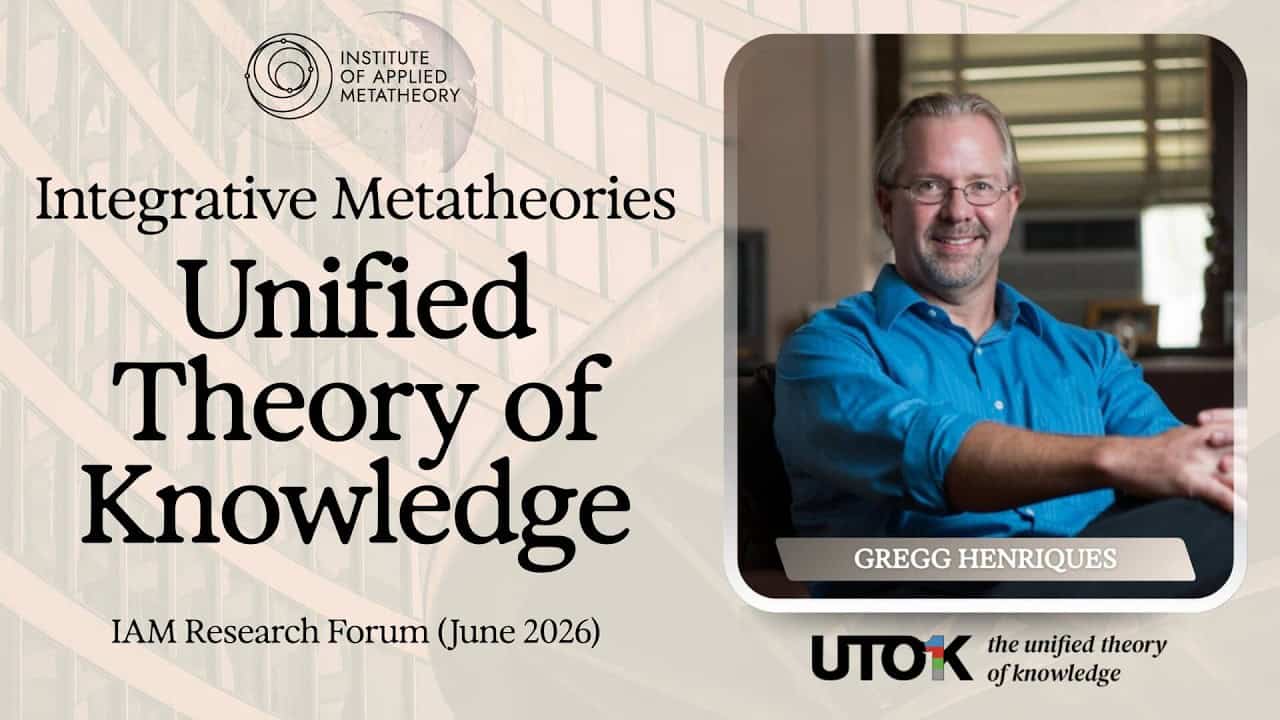
Modern science has produced an increasingly sophisticated picture of the physical world. Where it has persistently struggled is in placing mind and consciousness within that picture. Gregg Henriques calls this the Enlightenment Gap, and he argues it sits at the root of the metacrisis.
In this IAM Research Forum session, Dr. Henriques presents the Unified Theory of Knowledge (UTOK) as a natural philosophy built to close that gap. His diagnosis begins with what he calls gist ontology: we share a basic working picture of what matter is and what life is, yet we lack any comparable picture of mind. UTOK’s response pairs a transjective epistemology with a coherent naturalistic ontology. Scientific knowing operates alongside subjective experience and cultural meaning-making, each irreducible to the others, while the Tree of Knowledge system reorganizes the sciences around the successive emergence of matter, life, mind, and culture.
Psychology turns out to be the linchpin: the sciences cohere up to neuroscience, then fracture exactly where psychology should stand, and that fracture is what has kept the Enlightenment Gap open. Dr. Henriques closes with UTOK’s metapsychology and his new RAFTing model, which treats mind as a process ontology: the animal body is the raft, and mindedness is the activity of rafting it through the world. The discussion then takes up realism about the intersubjective domain, the questions UTOK leaves open, and what it contributes alongside integral theory and critical realism to building an ecology of integrated metatheories.
Watch or listen · 1:16:09
Gregg Henriques
“Yep.”
Chapters (7)
Held with integral theory
Where they meet. Henriques and Wilber both divide knowing into a two-by-two: inside and outside, individual and shared. Henriques says UTOK’s ways of knowing line up closely with Wilber’s quadrants, and he calls Wilber’s insight into the many valid ways of knowing a major one. Both also see each new level of nature as including the ones before it.
Is the exterior just matter?
The challenge. Henriques praises Wilber’s frame as a shorthand for how we know. His objection is to its picture of what exists. He argues that Wilber, like the behaviorist John B. Watson, ties the outside of things to matter, and he does not think insides and outsides divide reality that way.
The reply. Wilber says the Enlightenment took matter off the bottom rung of the Great Chain. In his account matter is the exterior of every level. A satori in the Upper Left shows up as brain patterns in the Upper Right, and neither one reduces to the other.
“And this happened particularly with the Western Enlightenment is that matter is not the lowest rung on the great chain.”
Ken Wilber
Become a member to hear it.
Where it lands. Mostly a matter of wording. Wilber’s “matter” is the outside of any level, and in the same talk he speaks of gross, subtle and causal matter. Henriques’s “matter” is the first level of nature, the one physics studies. A real difference remains: UTOK treats the outside of a mind as behavior, a new dimension of nature, and does not call it matter in any sense.
Can a map built from outside reach the inside?
The challenge. Integral theory holds that every interior can be known two ways. Wilber calls looking at the Upper Left from within zone one, “a pure interior phenomenology,” the ground of meditation and contemplation. Standing back to map it with models is zone two. UTOK defines its planes by behavior and complexity seen from outside, so integral would ask what such a map can say about the stages and states that open only from within.
“So if we look at the upper left quadrant, but do so in a specifically subjective stance from within, we get what we call zone one, a pure interior phenomenology.”
Ken Wilber
Become a member to hear it.
The reply. Henriques does not rank those ways of knowing below science. He says human knowing reaches the world “at minimum through a phenomenology, a narrative,” and also science, and he calls treating science as a “God equation,” with everything else meaningless, a view that makes “absolutely no sense.”
Where it lands. A real difference. Both give first-person knowing its own standing. For Henriques, phenomenology is how the world looks to a primate subject, one “table” set beside physics and tied to his structural model of mind. For integral, contemplative inquiry also discloses stages and states that can be found only by practicing an injunction and looking. That decides whether a meditator’s report of a higher state is data about the range of the mind or a fact about one person’s experience.
What holding both shows. The two maps may work as two axes: the quadrants as the perspectives on any holon, and UTOK’s planes of matter, life, mind and culture as the levels those perspectives look at. Integral brings the inside view of every level. UTOK brings a careful account of mind as its own level, which Henriques says most big pictures miss. Both lean toward process thought: Henriques calls mindedness a process, and Wilber takes prehension from Whitehead. Held together, they also leave both with one sharp question: if the outside of a mind is not matter, what is it?

About Gregg Henriques
Gregg Henriques is Professor of Graduate Psychology at James Madison University and a clinical and theoretical psychologist. He is the founder of UTOK, the Unified Theory of Knowledge, a system that bridges the sciences and humanities, and the author of UTOK: The Unified Theory of Knowledge (2024), A New Synthesis for Solving the Problem of Psychology (2022) and A New Unified Theory of Psychology (2011). He writes the Theory of Knowledge blog for Psychology Today. He is a fellow of the American Psychological Association and a licensed clinical psychologist in Virginia.