
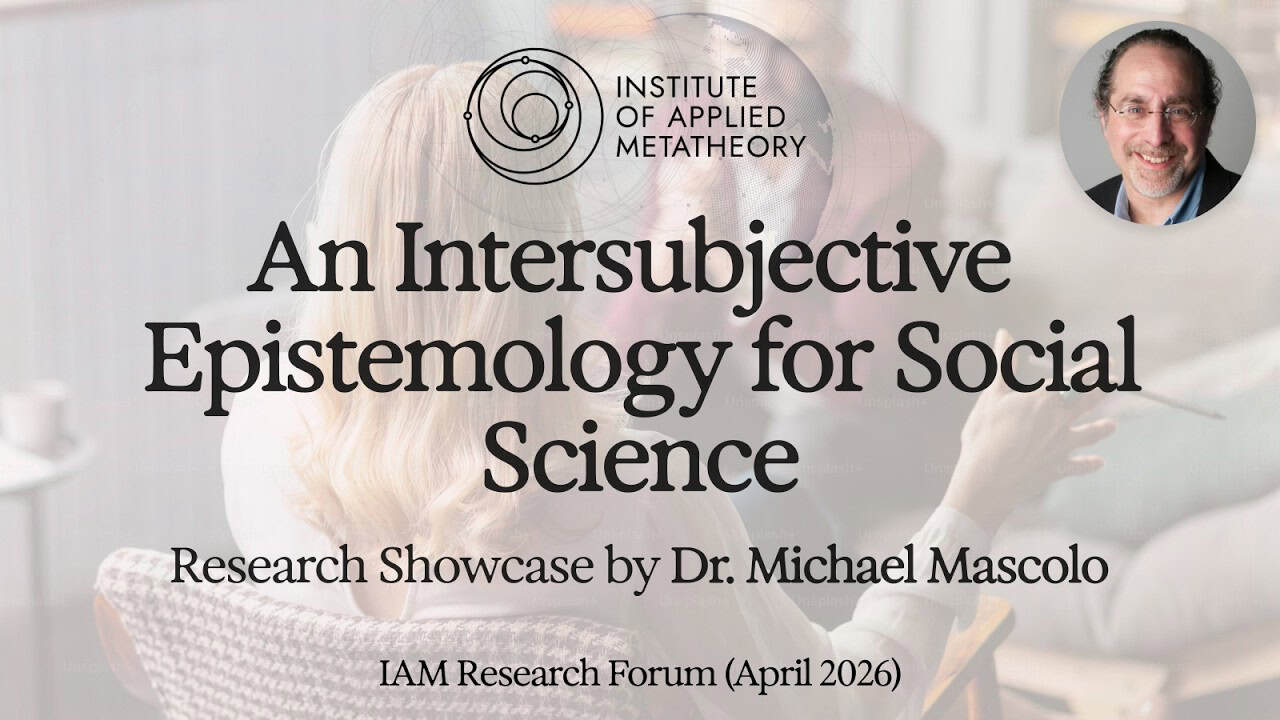
Dr. Michael Mascolo, Professor of Psychology at Merrimack College, presents a provocative challenge to psychology’s foundational assumptions about how we gain knowledge.
Drawing on Wittgenstein’s private language argument, mirror neuron research, and developmental psychology, Mascolo argues that both subjectivity and objectivity fail as sources of psychological knowledge. Instead, he proposes that all psychological understanding originates in intersubjectivity — the shared experiential space between people.
Mascolo traces how children learn to represent their own emotions not through introspection, but through a social process where caregivers name publicly visible expressions, and children then internalize those meanings. He extends this insight to argue that psychological science itself should be reconceived as a refinement of everyday intersubjective engagement, replacing the positivist model of theory tested against objective data with a hermeneutic process of corroboration across multiple intersubjective sources.
Dr. Michael Mascolo is a developmental psychologist, co-author of seminal papers with Kurt Fischer on skill theory and dynamic development, and founder of the Common Ground Institute.
Watch or listen · 51:31
Michael Mascolo
Michael Mascolo
“One of the things I so value about what you are doing in this process is looking at big picture questions and the whole idea of the crisis of meaning.”
Chapters (4)

About Michael Mascolo
Michael F. Mascolo is Professor of Psychology at Merrimack College in North Andover, Massachusetts, and the founding director of Creating Common Ground, a nonprofit that teaches people how to bridge divides on contentious social and political issues. He received his PhD from the University at Albany and did postdoctoral work at Harvard University. He has written or edited six books, including From Conflict to Collaboration: A Step-by-Step Guide to Solving Problems in Everyday Relationships and Psychotherapy as a Developmental Process (with Michael Basseches). He is also the founding editor of Pedagogy and the Human Sciences and a parenting and relationship coach.