
In this episode 8 chapters
- The Fourth Terminal Crisis
Robb Smith argues that the capitalist world system has broken for only the fourth time in 700 years.
- The Long Cycles of Capital
Robb traces capital's long cycles from Genoa through the Dutch and British to the U.S., showing how each hegemon's turn to high finance hollows out its productive classes.
- Keynes, Triffin, and the Bancor
Being the world's reserve currency gave the U.S. great power, but Keynes warned it would eventually impoverish the American middle class.
- Can China Lead the World?
Robb lays out what China could offer Europe, Japan, and the Global South, and how much its scale advantages matter.
- Europe's Bismarck Moment
Starting from a comparison between today's Europe and 19th-century Germany, Robb explains why rising contenders can endure pain better than rich countries.
- The Integral Play
Robb outlines what the integral community can do: build an integrative worldview, make the metacrisis an object of social action, and learn from the Mont Pelerin Society's model.
- From Nice-To to Have-To
Meg describes how quickly Canadians changed their views under annexation threats, and how her meditation students in China are reviving ancient wisdom.
- Babelfish and the Unfinished West
Robb expects English to stay entrenched, with AI translation dissolving language barriers, and suggests Chinese may even help with holistic thinking.
Perspective Shift:
- The system never loses — only hegemons do. The global capitalist system doesn’t collapse — it evolves. When a hegemon reaches its terminal crisis, the system reorganizes around a new cycle of accumulation, integrating more geography, people, and complexity. The fall of one power is not the end of order, but the beginning of a new one.
- Trade wars are class wars. The elites of global capitalism have benefited across borders, while productive classes have been hollowed out. What appears as a nation-to-nation trade war is often an uprising of the working and middle classes against an elite economic consensus — in both the U.S. and China.
- This isn’t just geopolitics — it’s a civilizational choice. The next hegemon will not only dominate economically — it will set the ideological container for the next global system. Whether that’s a pluralistic, integrative model or a rigid, authoritarian one depends on how we act now. The values embedded in the next system will shape the future of civilization.
- Anarchy is not chaos — it’s pre-order. We are not just losing order; we are entering a creative field of systemic renegotiation. The world is searching for its next organizing protocol — and this potential interregnum opens up space for bold experimentation, pluralism, and integrative synthesis.
- Strategy is not enough — consciousness must evolve. The next world system won’t emerge solely from institutional power. It requires a new level of integrative awareness among leaders, capable of seeing across lines of difference and holding long arcs of time. Spiritual and psychological maturity are not luxuries — they are strategic assets in an age of breakdown.
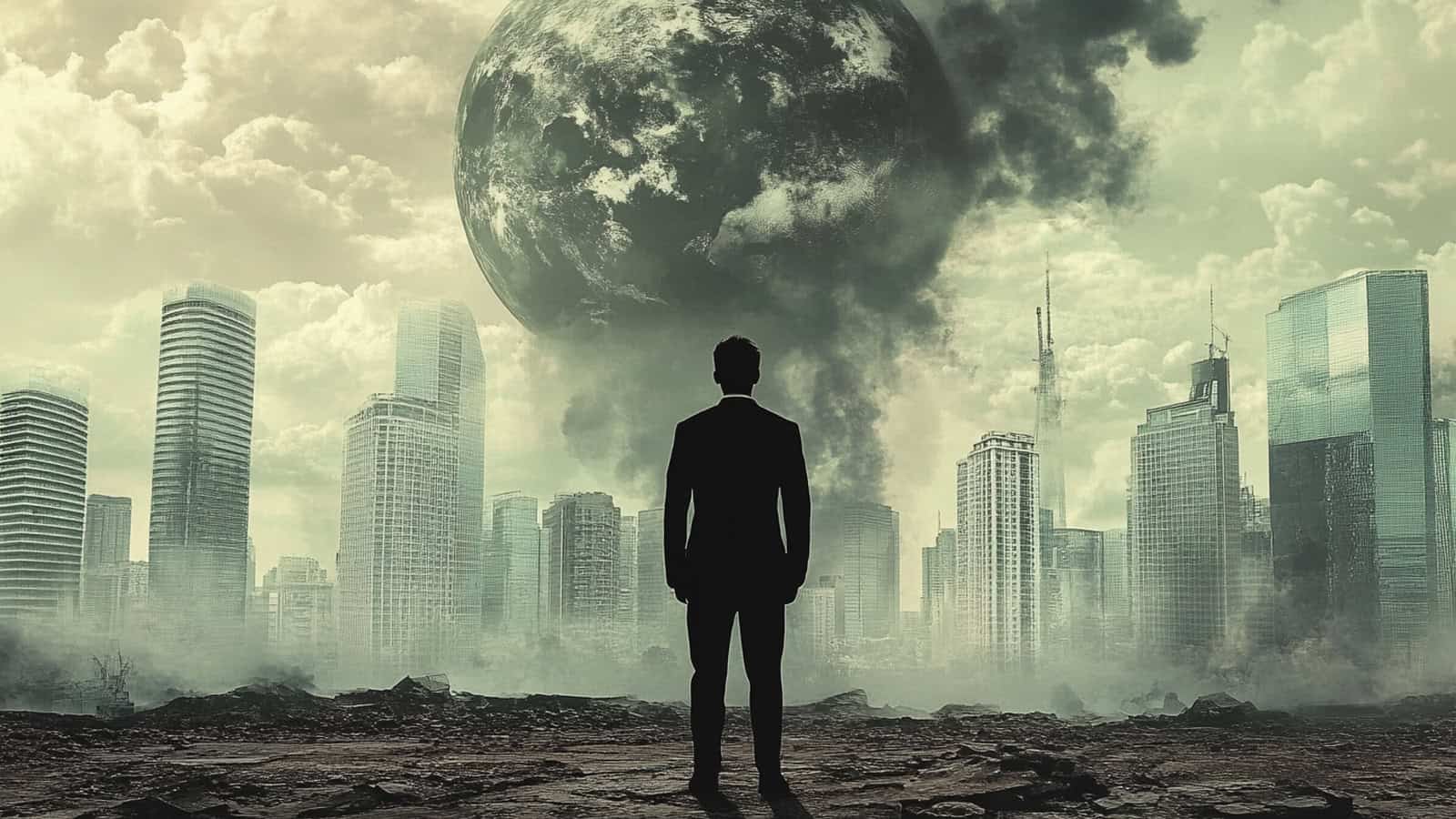
The global system is breaking — and it’s not the first time.
In this gripping new episode of Big Picture Mind, Robb Smith unpacks what he calls a “Terminal Crisis”—a rare moment in history when the prevailing financial hegemon (today, the United States) loses its grip on a system that is demanding reconfiguration. It’s the fourth such rupture in 700 years, following the Genoese-Iberian empire (1627), the Dutch United Provinces (1781), and the British Empire (1931). And now, in 2025, it’s America’s turn.
What happens next? We enter a period of global economic anarchy—a high-stakes reordering of capital, power, and institutions. Robb traces how the system always adapts, pushing forward into a new “cycle of accumulation” that includes:
- wider geographic integration,
- more complex economic coordination,
- expanded populations and markets, and
- institutional upgrades that solve for the contradictions of the previous cycle.
In this urgent and far-reaching conversation, you’ll learn:
- Why the U.S.–China rivalry is about far more than trade;
- How trade wars are also class wars;
- Why the global trust in American soft power has collapsed;
- What Keynes’ abandoned proposal—the Bancor—has to do with Bitcoin and the next reserve currency;
- What it will take to build a new integrative pluralism out of the ashes of today’s disorder.
Whether we descend into fractured blocs or step toward a new world order, one thing is clear: the system never loses — only hegemons do.
Comments? Questions? Join the discussion on our new community platform!
About The Big Picture Mind
We live in a moment of acute and profound change, a new “Transformation Age” witness to world-transforming, historic, paradigmatic shifts all happening at the same time: a geopolitical “great release”, a technoeconomic “singularity”, an ecological shift into the “Anthropocene”, the rise of “metasystematic” consciousness, a pervasive existential “meaning crisis”, and an epistemological shift into “hyperreality”. New capacities of human consciousness arise with the Transformation Age, with the most advanced human cognition in history emerging and producing a new post-postmodern worldview of nondual evolutionary panentheism, providing a new, credible 21st century story of wholeness and spiritual liberation. The world seems to desperately need what this worldview — named variously “integrative”, “integral”, “metamodern”, “complex”, and others — can offer in the face of these co-arising seismic shifts in the human condition, which collectively represent a threatening “metacrisis”, an emergent “metaxis”, and an opportunity to prefigure the first unity-in-diversity society in human history.
The Big Picture Mind aims to be an ongoing master course of integral thinking to help its participants build a mind capable of the holographic, cross-paradigmatic cognition needed in this era, and characteristic of the most advanced of the ten stages of consciousness in the world today. Each discussion will explain real-world events and dynamics by drawing on the leading-edge of integrative models, while exploring the kinds of challenging issues that the Institute of Applied Metatheory wrestles with every day across dozens of social impact arenas. Thank you for being here.
Previous Episodes of The Big Picture Mind

Become a member to access the full episode
Start building your big picture mind & support the global emergence of Integral consciousness

“Integral Life is the most important and globally-relevant platform for the leading edge of Integral consciousness evolution”
– Eugene P.

About Robb Smith
Robb Smith is a leading thinker on the Transformation Age and the global Integral movement. He is the creator of the augmented leadership platform Context, co-founder and CEO of Integral Life and founder of the Institute of Applied Metatheory.