|
Polarity Description
|
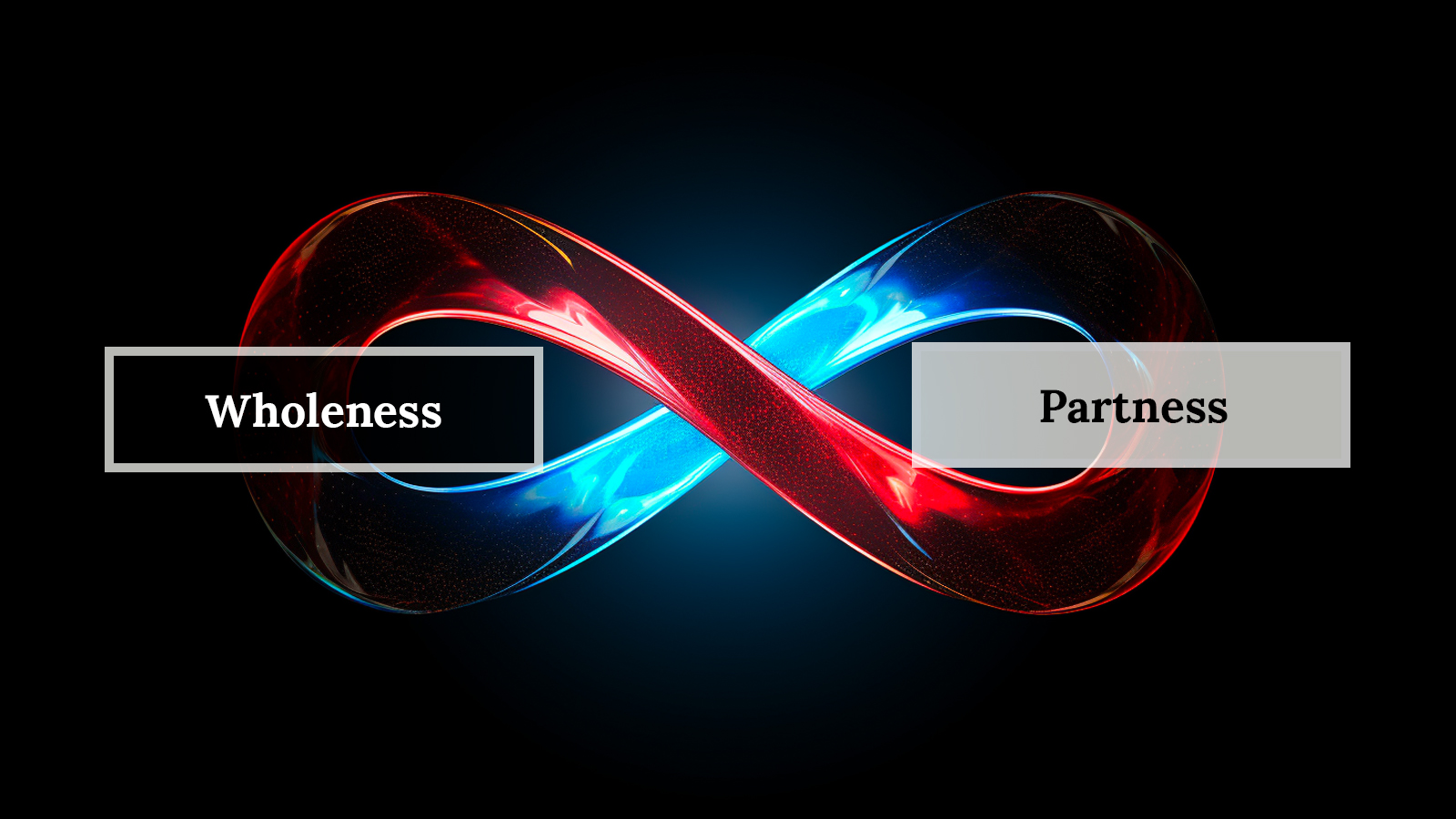
“Reality is not composed of things or processes; it is not composed of atoms or quarks; it is not composed of wholes nor does it have any parts. Rather, it is composed of whole/parts, or holons.”Ken Wilber, Sex, Ecology, Spirituality The polarity of Wholeness and Partness is a fundamental concept in integral theory, describing the dual nature of holons. Every holon, or whole/part, exists simultaneously as a whole in itself and as a part of a larger whole. This polarity highlights the tension between a holon’s autonomy and its participation in a broader context, and that balancing and integrating these two aspects is crucial for the healthy development and functioning of any holon. This polarity is not just a feature of physical entities but extends to all forms of existence, emphasizing the dual nature of being both independent and interdependent. It is a universal principle that applies to all levels of reality, from the subatomic to the cosmic, and is essential for understanding the nature of complex systems and the evolution of consciousness. Wholeness represents a holon’s autonomy, self-preservation, and agency. It is the aspect of a holon that maintains its distinct identity, coherence, and self-organizing capacity. Wholeness allows a holon to preserve its unique pattern and structure over time, even as it interacts with and adapts to its environment. This pole encompasses the holon’s capacity for self-regulation, self-maintenance, and self-transformation, enabling it to evolve and develop without losing its essential nature. Wholeness is the source of a holon’s individuality, creativity, and resilience in the face of change.
Partness represents a holon’s participation, communion, and embedding in a larger context. It is the aspect of a holon that allows it to interact with, adapt to, and be a part of something greater than itself. Partness enables a holon to contribute to and be shaped by the larger wholes in which it is embedded. This pole encompasses the holon’s capacity for communication, coordination, and co-evolution with other holons, allowing it to participate in the emergence of higher-order complexities and novel properties. Partness is the source of a holon’s relationality, adaptability, and capacity for transcendence. “A holon functions not only as a self-preserving whole but also as a part of a larger whole, and in its capacity as a part it must adapt or accommodate itself to other holons (not autopoiesis but allopoiesis; not assimilation but accommodation). The partness aspect of a holon is displayed in its capacity to accommodate, to register other holons, to fit into its existing environment. Even electrons accommodate themselves, for example, to the number of other electrons in an orbital shell; they register, and react to, their environment. This doesn’t imply intentionality on the part of the electron, just a capacity to react to surrounding actions. As a whole, it remains itself; as a part, it must fit in.”Ken Wilber, Sex, Ecology, Spirituality |
|
Integrated Polarity
|
|
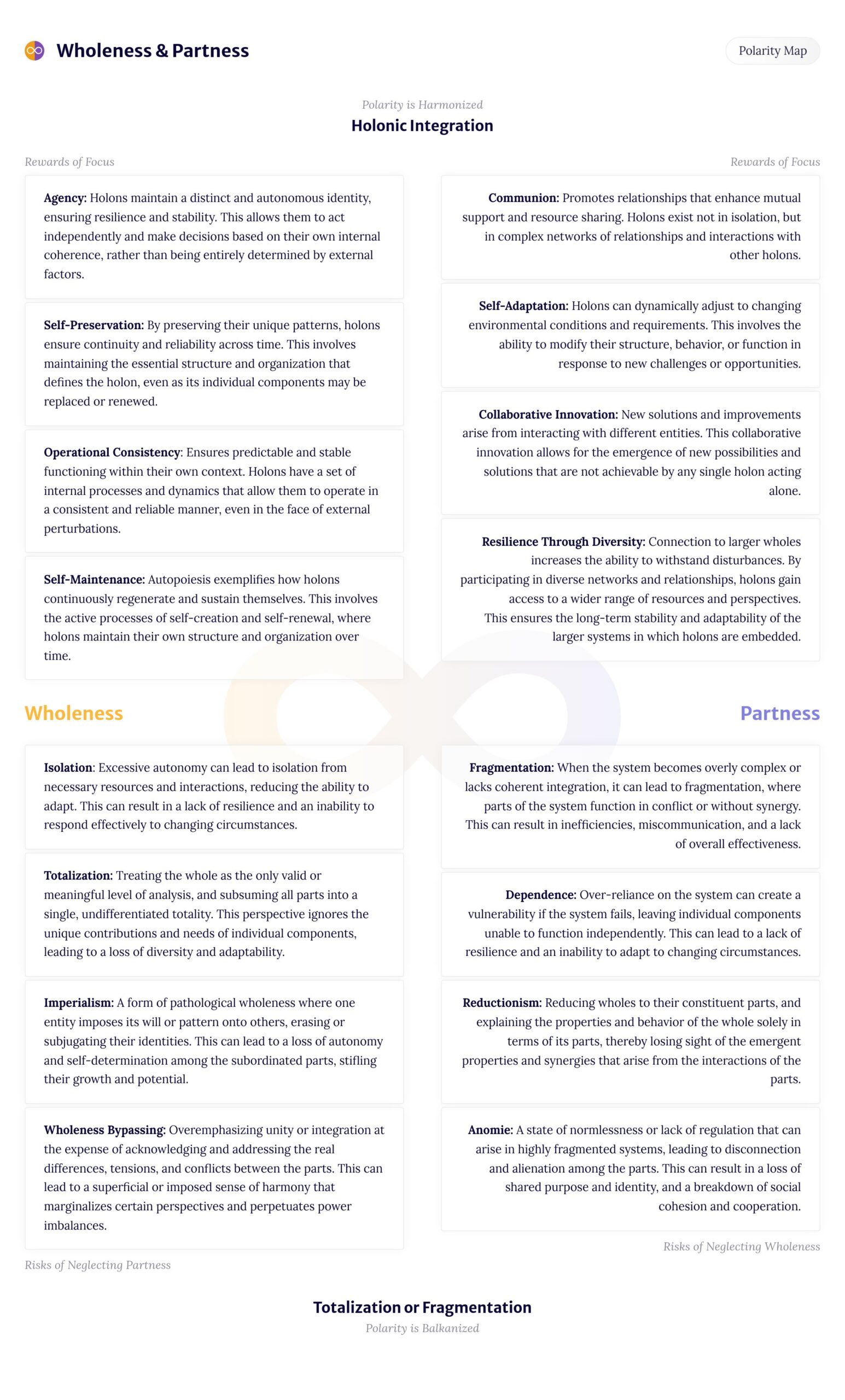
Holonic Integration represents the harmonious and dynamic balance between the wholeness and partness of a holon. In this state, the holon maintains its distinct identity and autonomy while actively participating in and contributing to the larger wholes of which it is a part. Holonic Integration allows for the seamless flow of information, energy, and resources between different levels of the holarchy, enabling the holon to adapt and evolve in response to changing circumstances. This state of integration is characterized by a recognition of the interdependence and mutual support between the parts and the whole, leading to a sense of coherence, resilience, and purposeful engagement with the world. Note: Polarity maps such as this one are themselves an exercise of holonic integration, helping us to appreciate and attend to both whole and part simultaneously. As you work with the polarity of wholeness and partness, it’s important to recognize the meta-nature of this polarity and how it relates to all other polarities. In a sense, wholeness and partness are the fundamental building blocks of all polarities, as each pole represents a whole in itself, while also being a part of the larger polarity. By understanding this meta-perspective, you can begin to engage with all polarities in a more holistic and integral way. When working with any polarity, take time to appreciate each pole as a whole in itself, with its own unique qualities, perspectives, and contributions. Then, explore how each pole is also a part of the larger polarity, and how they relate to and complement each other. Finally, consider how the polarity as a whole is a whole/part in itself, nested within larger contexts and systems. In practical terms, managing this polarity involves an iterative, ongoing process:
“This primordial polarity runs through all domains of manifest existence, and was archetypally expressed in the Taoist principles of yin (communion) and yang (agency). Koestler: “On different levels of the inorganic and organic hierarchies, the polarisation of ‘particularistic’ [agency] and ‘holistic’ [communion] forces takes different forms, but it is observable on every level.”Ken Wilber, Sex, Ecology, Spirituality |
|
Disintegrated Polarity
|
| Totalization and Fragmentation represent the breakdown of the wholeness-partness polarity, leading to a state of imbalance and dysfunction. With Totalization, the wholeness of the holon is overemphasized to the point of subsuming all parts into a single, undifferentiated totality. This leads to a loss of diversity, creativity, and adaptability, as the unique contributions and needs of the parts are ignored or suppressed. In Fragmentation, the partness of the holon is overemphasized to the point of losing coherence and integration. This leads to a state of disconnection, conflict, and inefficiency, as the parts struggle to function in isolation from the larger whole. The oscillation between Totalization and Fragmentation creates a vicious cycle that undermines the health and development of the holon. |
|
Tips for Harmonizing
|
| To harmonize the polarity of wholeness and partness, cultivate practices that promote both autonomy and integration. When you find yourself leaning too far into wholeness at the expense of your parts (totalization), focus on practices that honor the diversity and uniqueness of the parts, such as encouraging individual expression, fostering open communication, and celebrating differences. When you find yourself leaning too far into partness (and feeling increasing fragmentation), focus on practices that strengthen connections and collaboration, such as building shared vision, establishing clear roles and responsibilities, and creating opportunities for synergy and cooperation. |
|
Tips for Integrating
|
Integrating the wholeness-partness polarity is a multifaceted and ongoing process that requires engaging all dimensions of our being. It involves growing in our capacity to hold complexity, awakening to deeper levels of consciousness, healing our inner divisions, expanding our understanding, and showing up in the world with greater wholeness and integration. The following practices offer a comprehensive approach to realizing the full potential of this fundamental polarity in our lives and in the larger systems we are a part of.
|
Related Media
Holons: The Building Blocks of the Universe
Corey deVos
Join Corey deVos for this fun, fascinating, and far-reaching exploration of one of the essential cornerstones of integral theory — holons, or the apparently endless series of “part/wholes” that fundamentally compose reality as we know it. Accompanied by music, imagery, and animation, this presentation will not only help you better understand what a holon actually is (and what it isn’t!) but also how this understanding can radically deepen your appreciation for the natural world, and for all of the other holonic intelligences that exist alongside us on this planet.
From Polarization to Integration
Ken Wilber and Corey deVos
Ken Wilber and Corey deVos explore some of the causal factors behind so many of the regressive tendencies in our culture and politics these days, from new social pressures coming from social media technologies like Facebook, to the historic evolutionary trends that have formed and informed our major schools of political thought in the first place.
Recommended Training
with Beena Sharma
Integrating Polarities is a revolutionary new training program by Beena Sharma, designed to teach you the higher-order thinking common to leading-edge individuals at the integral stage of development. This training is designed to model the higher-order thinking associated with integral stages of psychological maturity, offering you a step-by-step process to help you learn these thinking skills and apply them to your life, your relationships, and your work in the world.
Enroll Now
More Polarity Maps


About Corey deVos
Corey W. deVos is editor and producer of Integral Life. He has worked for Integral Institute/Integal Life since Spring of 2003, and has been a student of integral theory and practice since 1996. Corey is also a professional woodworker, and many of his artworks can be found in his VisionLogix art gallery.