
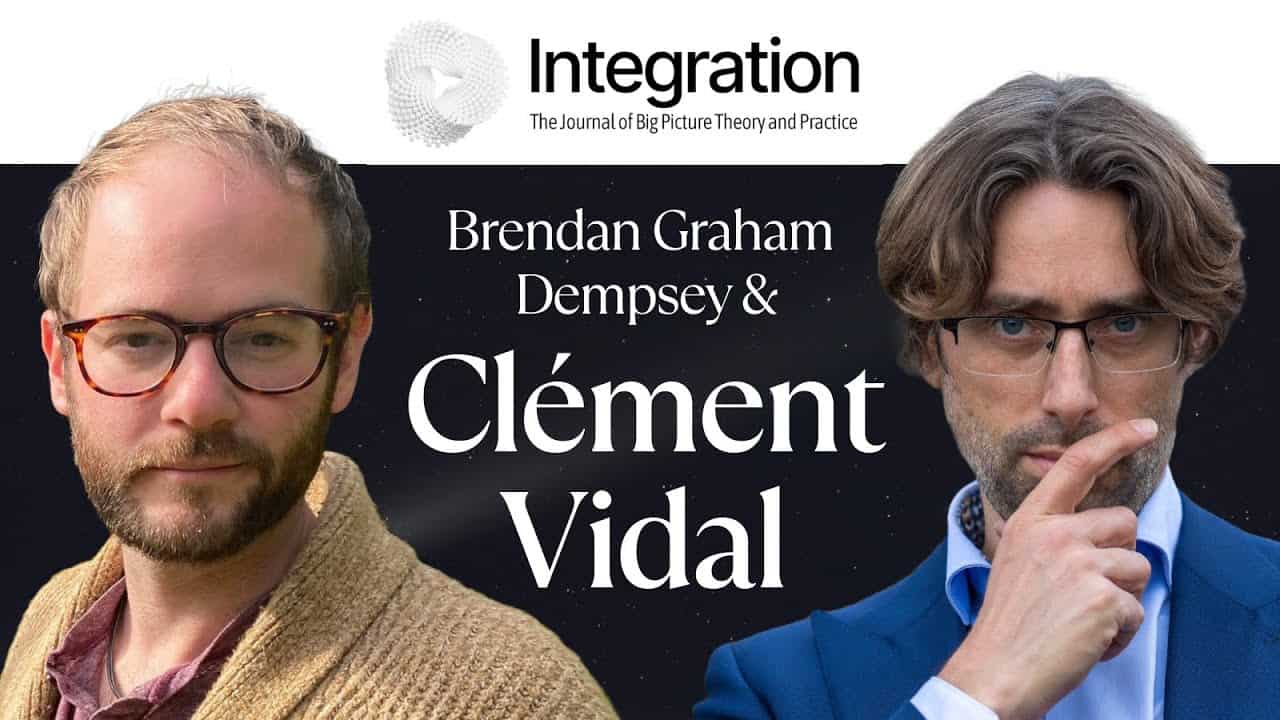
Dr. Clément Vidal discusses the work coming out of the Evo-Devo community and his contributions to theorizing the concept of worldview before unpacking the core aspects of a so-called “cosmic evolutionary” worldview, whose ideas resonate deeply with the integrative worldview being developed by the Institute of Applied Metatheory. We unpack his ideas around cosmological artificial selection and its connection to various forms of metaphysics, as well as how value(s) relate to this cosmic picture.
Watch or listen · 1:17:04
Clément Vidal, Brendan Graham Dempsey
Brendan Graham Dempsey
“Awesome. So there's so much here I'd love to get into.”
Chapters (7)
Held with integral theory
Where they meet. Vidal and Wilber both reject the view that evolution is pure chance. Vidal asks whether galaxies, life and intelligence are “lucky accidents” or “embedded in the fabric of the universe,” and he wants to lift the taboo on direction in evolution. Wilber calls the drive toward higher order Eros, and he says science now calls it self-organization.
Who tuned the universe?
The challenge. Vidal weighs the answers to fine-tuning. Chance needs something like 10 to the 500 universes, which he calls “very eccentric scientifically.” A supernatural God “comes with all the other problems of theology.” His own scenario, cosmological artificial selection, has intelligent life in an earlier universe make or steer ours. A naturalist would put the same charge to integral’s Spirit-in-action: it explains a direction in nature by something outside nature. Vidal grants his own scenario’s cost: it moves the question back a step.
The reply. Wilber agrees that fine-tuning proves less than believers want. Such arguments, he says, point at most to “a ground of being,” with no “fine tuner named Yahweh,” and it “doesn’t even have to have a separate subjective self.” Elsewhere he calls the creative drive “inherent to the universe at all levels,” and Spirit is how that drive reads “if you’re still including spirituality in your account.”
“Wow. And I mean, these are really, that's why the anthropomorphic principle has become a primary argument for the people arguing for God's existence.”
Ken Wilber
Become a member to hear it.
Where it lands. A real difference, narrower than it looks. Neither needs a supernatural designer. Vidal’s tuners are natural beings in an earlier universe, and he calls the view “a kind of deistic, naturalistic, theistic view.” Wilber’s ground is not a being at all. What divides them is whether the chain of universes needs a ground, which is the next question.
Does an endless chain of universes explain itself?
The challenge. Asked whether the laws of physics might have begun as early habits of the universe, Wilber says that’s fine, then asks where that came from. Most philosophy, East and West, answers ultimate questions with “something from the relative world,” he says, and Nagarjuna would reply that you need “an experience of ultimate truth.”
“And I think that if you look at, sort of keep the two truths doctrine in mind, and then you look at what most philosophy has done, East and West…”
Ken Wilber
Become a member to hear it.
The reply. Vidal accepts the regress and denies that it is a flaw. In the metaphysics he ended up with, nothing is contradictory about an infinite cycle of universes making one another. It is only “very uncomfortable for the mind.”
Where it lands. A real difference. For Vidal, “where does it all come from?” asks about the past, and an endless chain can answer it. For Wilber it also asks about the ground of this moment, and only “an experience of ultimate truth” answers that. The difference decides whether one of the big worldview questions has a third-person answer at all.
What holding both shows. The two pictures may answer different questions. Vidal’s cycle gives a history in time. Wilber says the unfolding since the Big Bang is “also repeated moment to moment out of that empty origin right now,” and an endless history doesn’t rule that out. Their ethics run close too. Vidal seeks “win-win to the exponent N” across all the systems a person holds in awareness, and Wilber’s basic moral intuition asks for “the greatest depth for the greatest span.” Vidal’s scales are span, and his developmental values, for people who grow “to higher and higher stages,” come close to depth. He also says most scholars in this space “would hold a kind of process metaphysics,” which ties both to process philosophy in this series.
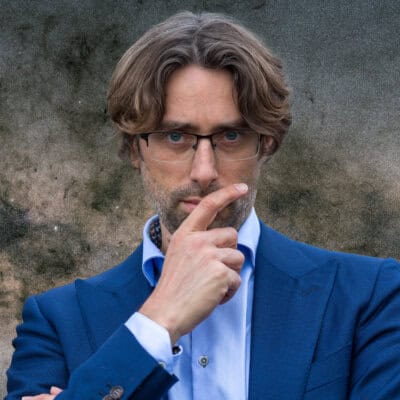
About Clément Vidal
Clément Vidal is a philosopher with a background in logic and cognitive sciences. He co-founded the Evo Devo Universe community, and in 2022–2023 he was a visiting scholar at the Berkeley SETI Research Center at UC Berkeley. He is the author of The Beginning and the End: The Meaning of Life in a Cosmological Perspective (2014). His work brings together cosmology, physics, astrobiology, complexity science and evolutionary theory to address big questions.