

In this episode 14 chapters
- Painting the Subtle Body
Ken opens by praising Alex's art for making subtle energy visible.
- A Separate Intelligence
They treat seeing subtle energy as a gift that is separate from awakening itself, and note how rarely modern artists train in higher states.
- Bodies for Every State
Ken lays out the Vedanta and Vajrayana teaching that gross, subtle and causal bodies support waking, dreaming and formless states.
- Gaia on the Brooklyn Bridge
Alex explains that the Gaia painting came as a vision while he drove across the Brooklyn Bridge the morning after his daughter was born.
- Premonitions of 9/11
After 9/11, people pointed out the twin towers and airplanes hidden in Gaia, and Alex recounts other uncanny artworks that seemed to foresee the attacks.
- The Net of Being
Alex describes a vision catalyzed by ayahuasca of infinite, interlinked beings in which the heart of one layer is the head of the next.
- Deranging the Normalcy Trance
Alex talks about psychedelics as sacred tools that require surrender and a healing setting, and about how they saved him from suicidal despair over a flatland world.
- Hofmann's Bicycle Day
Alex tells the full story of Albert Hofmann discovering LSD, from the inner voice that told him to make it again, to the fearful bike ride home, to the return of his childhood mysticism.
- Entheogens at the Roots
Alex names LSD as his most trusted ally for painting and points to the Eleusinian mysteries and Vedic soma as evidence that psychedelics stood at the foundation of both Eastern and Western…
- Politics of Consciousness
Ken and Alex criticize how cultures outlaw certain states of consciousness, from the harsh prison sentences for psychedelics to the failure of Prohibition and the violence at the Mexican border.
- The Cosmic Christ
Ken describes Cosmic Christ, a figure woven from dozens of story panels.
- Planetary Crucifixion
Alex explains that the painting places the Earth at Christ's heart, with every race nailed to one another in a painful interconnectedness, and frames it as humanity's choice between self-destruction…
- Lightworker
Alex describes a commission for an electrical contractor: a figure running on a wire with his shoulder to a sine wave of light, showing that all energy is human-powered.
- Theolog's Infinite Grid
Ken explains why Theolog is his favorite: a meditator woven into mountains, flames and a lattice of light.
Alex Grey and Ken Wilber take us on a breathtaking journey through five of Alex’s paintings — Gaia, Net of Being, Cosmic Christ, Light Walker, and Theologue — offering an intimate glimpse into the creative process, the nature of reality, and the unique capacity art possesses to awaken the viewer with a single glance.


In Praise of Alex Grey and Ken Wilber
In our media saturated world it is easy to waffle between two poles of evaluative numbness: excessive and uncritical praise, like that heaped on a celebrity; and the ennui of deadened indifference or scorn, hiding a secreted sense of one’s superiority.
It sometimes takes more than a moment of reflection to awaken from this collective slumber.
But it’s time to wake up.
For Alex Grey and Ken Wilber warrant our wide-eyed praise and appreciation.
Alex Grey might be the most significant artist alive. In a world gone postmodern, bereft of meaning and value, cut loose on a sea of irony and indifference, Alex is taking a stunning stand: there is a God, there is Spirit, there is a transcendental Ground and Goal of human development and unfolding. Higher realities are available to us, is the message of Alex Grey’s art… He has set himself the extraordinary task of depicting, in art, these higher truths and here encourages all artists to find their own unique means of serving art’s abiding mission.Ken Wilber
Alex: No contemporary visual artist has done more to explore and enact in his or her art the radiant and luminous trans-lineage worldspaces of what is actually coming to be.
Ken: No contemporary theoretic writer has done more to research and craft with such patience and care psychoactive maps of the trans-lineage worldspaces of what is actually coming to be.
Prior to Alex and Ken (and their generation) the collective sense of any sort of trans-lineage spirituality was murky. After them, and in no small way due to their efforts, this Way is now Cleared for those of us who come after.
Both are courageous pioneers of the visual and verbal disclosures of an emergent spirituality proper to our ever striving, evolving, and timelessly-at-peace Unique and True Selves. The great postmodern American artist Jasper Johns concluded his obituary for Marcel Duchamp in saying:
“He has changed the condition of being here [as an artist].”1
We can say the same of Alex and Ken about what it can mean to be a spiritual realizer today.
A deep bow of gratitude to these two blessed souls – clear-sighted praise.
Which brings us to the crux—our inviting you to engage these artworks and the audio discussions about them with beginner’s eye and mind.
Written by Michael Schwartz
November 2011
1 Jasper John, “Marcel Duchamp [1887-1968],” in Art in Theory 1900-2000: An Anthology of Changing Ideas, new edition, eds. Charles Harrison and Paul Wood, 2003, p. 761 (originally: Artforum, November 1968, p. 6).

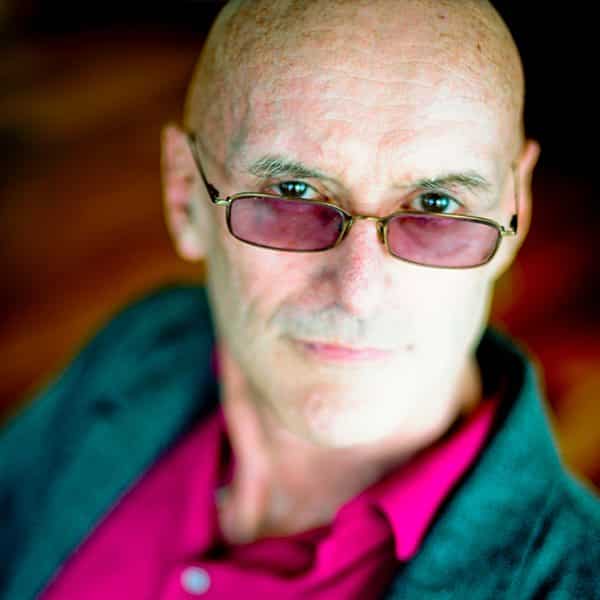
About Ken Wilber
Ken Wilber is a preeminent scholar of the Integral stage of human development. He is an internationally acknowledged leader, founder of Integral Institute, and co-founder of Integral Life. Ken is the originator of arguably the first truly comprehensive or integrative world philosophy, aptly named “Integral Theory”.
