

In this episode 11 chapters
- Architecture That Pulls Us Upward
Ken introduces Mark DeKay's Integral Sustainable Design, the first book to apply integral theory to architecture, and argues that buildings can help people transform.
- A Designer's Journey Through Quadrants
Mark describes moving from two decades of energy-focused work to systems thinking and then to the cultural perspective.
- Six Inches of Water
They walk through the book's design principles for each quadrant, including Mark's image of the water cycle shrunk to the six inches between tap and drain.
- You Can't Argue Someone Up
Rating systems like LEED are important but partial, and seeing living systems takes a level of cognitive development, not just a change of quadrant.
- Where Are the Interiors?
The book proposes ecological shifts from consumption to metabolism and from objects to relationships, while criticizing systems theory for leaving out meaning, ethics and aesthetics.
- Buildings as Third Skin
Buildings pass on the consciousness of their makers and can raise or lower a culture's awareness, yet sustainable design says almost nothing about delight.
- Levels of Aesthetic Worldview
Designers have to develop their own perception through inner practices, and research by Alexander and Housen suggests people broadly agree on what feels alive.
- Lines and Prospects of Design
Mark lays out six lines of development an architect needs and how he built them into a graduate program.
- A Designer's Integral Yoga
Ken reads the four designer profiles, from eco-manager to eco-integralist, and the book calls for an integral transformative practice for designers.
- Five Natures, Not One
Modeling design on living systems takes shifts in perception, and each level of development brings forth a different nature.
- Beauty as Access to Spirit
Buildings designed from transpersonal awareness can spark peak experiences that draw people toward higher stages.
Of all the different forms of art we are exposed to every day, none has as significant an effect upon our moods, behaviors, and state of mind as architecture. We define ourselves by our architecture, every building we see emphasizing varying combinations of Beauty, Goodness, and Truth, filtered through the ever-changing aesthetics, values, and technologies of society. Each architectural design represents both the individual’s image of society, as well as society’s image of itself — a gateway between interior and exterior, between culture and consciousness, and between the past and the present. Each style represents a unique alchemy of ever-deepening form, function, and meaning, balancing masculine and feminine design elements in very distinctive ways from building to building, culture to culture, epoch to epoch.
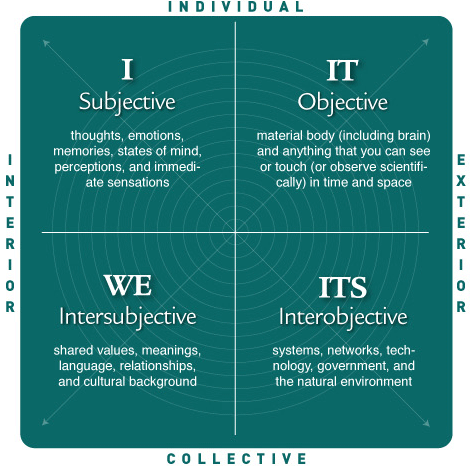 In this dialogue, Mark DeKay talks to Ken Wilber about his new book Integral Sustainable Design. Mark and Ken look at the world of architecture and design through the lens of the Four Quadrants. For example:
- The need to design profound aesthetic experiences (Upper-Left Quadrant, personal)
- Designing for cultural communication by using the symbolic language of architecture (Lower-Left Quadrant, cultural)
- Maximizing the efficient use of water, energy, and natural resources while minimizing waste and pollution (Upper-Right Quadrant, behavioral)
- Customizing the design to fit the economics, building systems, and relationships of the local neighborhood, region, and ecosystem (Lower-Right Quadrant, social)
Our buildings are alive with memory. They represent a sliding calculus of perspectives, circumstances, and social priorities that became codified into architectural design. Our constructions continue to construct us, imprinting our personal and collective identities in subtle but powerful ways—creating not just physical landmarks, but landmarks of experience that are always coloring our perspectives, housing our visions, and sheltering our dreams. Listen as Mark and Ken explore the deepest and most profound potentials of Integral design and architecture.
Written by Corey W. deVos
Become a member to access the full episode
Start building your big picture mind & support the global emergence of Integral consciousness

“Integral Life is the most important and globally-relevant platform for the leading edge of Integral consciousness evolution”
– Eugene P.

About Mark DeKay
Mark DeKay specializes in Sustainable Design theory, research, design tools, and practice. He is a registered architect and has taught at the university level since 1994. Prof. DeKay's research interest is in energy and environmental issues in building design and urban design, specifically, the impact of design decisions on environmental quality and the study of how to create ecological integrity through the form and organization of the built environment. Professor DeKay's recent work is in Integral Theory and its applications to Sustainable Design and to design education. His book, Integral Sustainable Design: Transformative Perspectives, was published by Earthscan in 2011.
About Ken Wilber
Ken Wilber is a preeminent scholar of the Integral stage of human development. He is an internationally acknowledged leader, founder of Integral Institute, and co-founder of Integral Life. Ken is the originator of arguably the first truly comprehensive or integrative world philosophy, aptly named “Integral Theory”.
